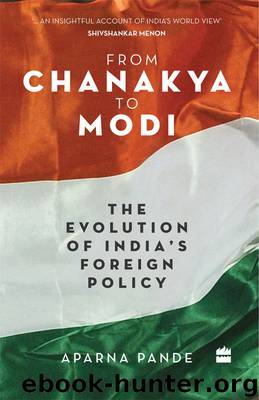
From Chanakya to Modi: Evolution of India's Foreign Policy by Aparna Pande
Author:Aparna Pande [Pande, Aparna]
Language: eng
Format: azw3, epub
Tags: null
Publisher: HarperCollins Publishers India
Published: 2017-07-10T04:00:00+00:00
The South Asian region has always received the greatest attention from the makers of Indian foreign policy. At Independence, India inherited borders or imperial fault lines that have impacted ties with all its neighbours. India is the largest and most populous country in South Asia, with the largest economy and the biggest armed forces. This threatens some neighbours and overwhelms others. India is also the only country in the region that shares land or sea borders with other member states of the South Asian Association for Regional Cooperation (SAARC), with the exception of Afghanistan.
India is sometimes described as the region’s ‘big brother’ with whom several neighbours have border disagreements. Some of India’s neighbouring states were once part of an Indian Empire while others emerged as separate kingdoms within a vast Indian civilization. India is the geographical, sociocultural and economic centre of South Asia and, in the words of former diplomat S.D. Muni, India’s centricity in the region is because ‘there is a bit of India in every other country of South Asia’.18As is often the case involving smaller neighbours of a large country, it is easy to fuel resentment or fear of domination among India’s neighbours.
Concerns of neighbours notwithstanding, India has not pursued a hegemonic or expansionist policy under any government or leader. Some leaders have sought unequivocal peace with neighbours (e.g. the Gujral doctrine) while others have sought amity based on reciprocity or quid pro quo (e.g. the Indira doctrine). None, however, have sought to take over neighbours’ territory. That has not deterred India’s neighbours from viewing India as hegemonic or imperialist. Over time, such views have diminished among most of India’s neighbours with the exception of Pakistan, which continues to suspect India of wanting to dominate South Asia. Islamist ideologues in Pakistan go so far as to allege that India’s real ambition is to recreate a Brahmin empire across the subcontinent.
Ironically, it is not the ancient Hindu empires that inspire India’s view of its immediate neighbourhood. Modern India’s perception of its environs originates from the days of the British Raj. Different Indian leaders have seen the region stretching from the Gulf to South-East Asia as important to India, just as the officials of the Raj saw it, albeit with a different focus. For the British, India was the nucleus of an overseas empire, a base from which they could rule, control and defend lands distant from the British homeland.
After Independence, Nehru focused on Asia where he sought to act as leader of a vast continent that was just emerging from Western colonial rule. He did not think in security terms, at least until the war with China in 1962. In Nehru’s view, bilateral treaties of friendship and peace with the three northern Himalayan kingdoms – Bhutan, Nepal and Sikkim – and an offer of a no-war pact to Pakistan19 was enough to deal with South Asia, freeing him to seek prominence on the Asian and global stage.
The notion of the subcontinent as India’s backyard attained centrality under Indira Gandhi.
Download
From Chanakya to Modi: Evolution of India's Foreign Policy by Aparna Pande.epub
This site does not store any files on its server. We only index and link to content provided by other sites. Please contact the content providers to delete copyright contents if any and email us, we'll remove relevant links or contents immediately.
| Anthropology | Archaeology |
| Philosophy | Politics & Government |
| Social Sciences | Sociology |
| Women's Studies |
The Secret History by Donna Tartt(19305)
The Social Justice Warrior Handbook by Lisa De Pasquale(12224)
Thirteen Reasons Why by Jay Asher(8998)
This Is How You Lose Her by Junot Diaz(6958)
Weapons of Math Destruction by Cathy O'Neil(6370)
Zero to One by Peter Thiel(5868)
Beartown by Fredrik Backman(5839)
The Myth of the Strong Leader by Archie Brown(5552)
The Fire Next Time by James Baldwin(5506)
How Democracies Die by Steven Levitsky & Daniel Ziblatt(5272)
Promise Me, Dad by Joe Biden(5190)
Stone's Rules by Roger Stone(5130)
A Higher Loyalty: Truth, Lies, and Leadership by James Comey(5017)
100 Deadly Skills by Clint Emerson(4973)
Rise and Kill First by Ronen Bergman(4839)
Secrecy World by Jake Bernstein(4798)
The David Icke Guide to the Global Conspiracy (and how to end it) by David Icke(4772)
The Doomsday Machine by Daniel Ellsberg(4556)
The Farm by Tom Rob Smith(4550)
